Chapter Two - Seagraves
Road, Coventry 1952-1960
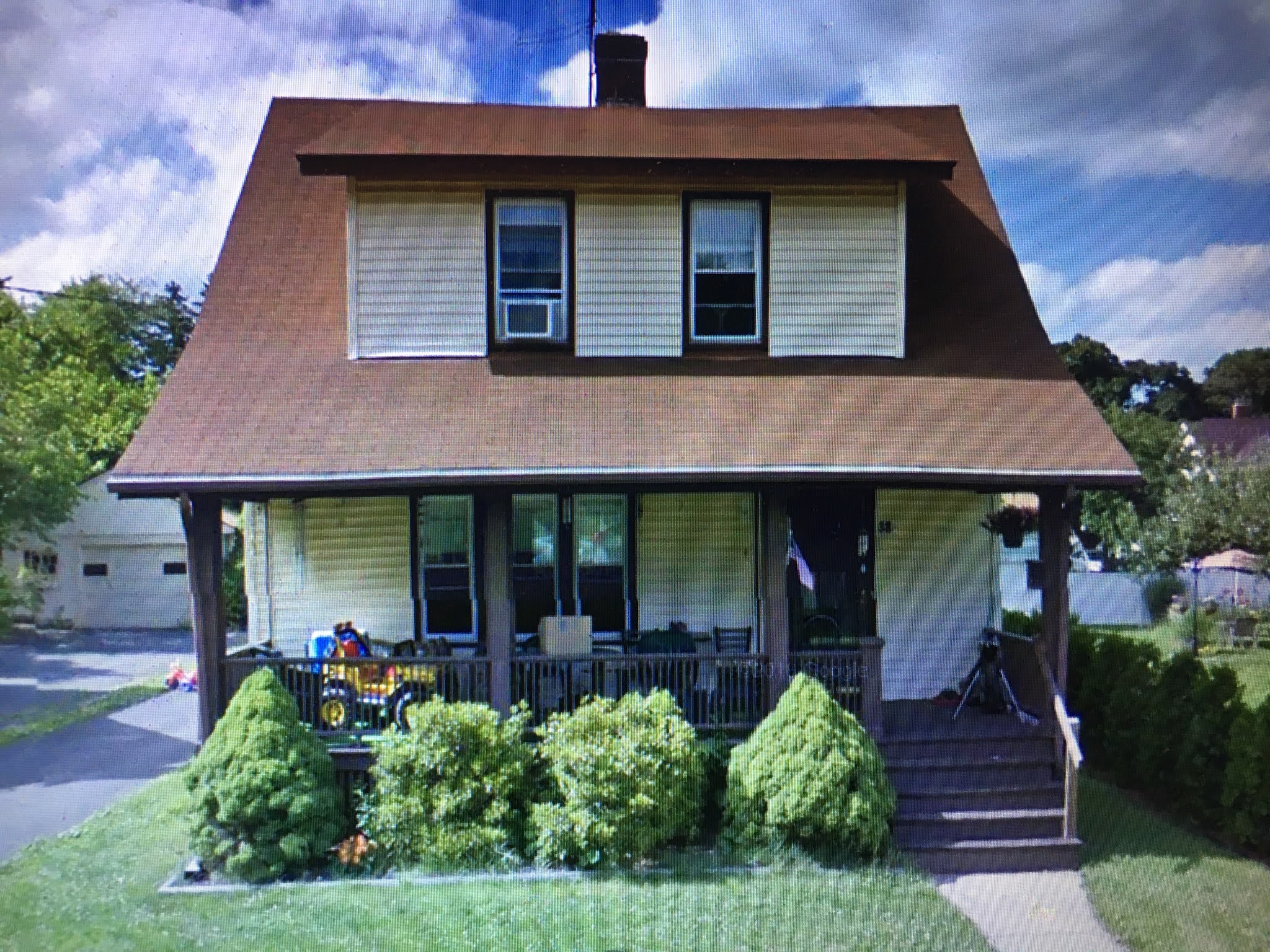
We moved to 26 Seagraves Road, Coventry,
Connecticut, in 1952 (I don't remember the houses having numbers back then). Dad had gone into partnership with Bill Dorsey at a Shell Station. Their company was D&H (Dorsey and Hotchkiss) Auto Service, 1960
South Street (near Beebe Farms Road and Camposio Drive).
Coventry was a strange town. It had been a farm town and a mill town. In the '50s, there were still a few mills and a fair number of working farms. We got our milk from a local farm. Like many post-war (WW2) towns, things were changing.
Connecticut was a manufacturing state, and there was nothing bigger than Pratt & Whitney in East Hartford. It seemed like half the adult population of Coventry worked for Pratt, or a company with military contracts.
By 1960, Coventry's population had grown to 6,356, from 4,043 in 1950, according to the US Census. There was one new development in town off Flanders Road, near South Street. I think it was called Nathan Hale Heights. It was built by Joe Gorris. As well, many of the summer cottages around Wangumbaug Lake became year-round homes.
Official policing was performed by the Connecticut State Police, although there were some men with "Sheriff" badges. From what I remember, they were derisively called the Coventry Cowboys. And not because the rode horses.
The Coventry Fire Department (there were two, one in North Coventry and one in South Coventry) was a volunteer affair. My Dad was a member of the South Coventry FD. I don't want to cast aspersions on present-day volunteer fire departments, but back in the '50s my Dad used to say their primary job was to keep a fire from spreading.
In some ways, Coventry was like the Wild West. There were shootings - one I remember was over a woman, a married woman. Evidently, hubby found out this known Lothario was messing with his wife. Hubby grabbed his .22 rifle and tracked down Lothario, shooting him. I don't think there were any charges.
There were three or four drinking establishments in town, none of which were family-friendly. At the north end of the lake, at the intersection of Daly Road and Main Street (Rt. 32) was The Cove. The Cove had a restaurant with "dinner and dancing" and a separate bar.
 |
| The Cove. The restauant on the left, the bar on the right. |
At the south end of the Lake was, ta-da, Lakeside, another restaurant and bar, that was even more of a dive than The Cove. Lakeside is now Lakeview Restaurant & Bar, a nice family place.
In the center of town was Bidwell's, next to Flaherty's Package Store, in the old Bidwell Hotel. I think Bidwell's was the diviest dive in town. Bidwell's was reborn in a brick building just up the street in the late '60s, and has become another respectable restaurant and bar.
 |
| Bidwell's Hotel. The original Bidwell's bar was on the ground floor, left side. The package (liquor) store on the right side. |
 |
| In the late 1960s this brick building, formerly a mill office, and then the Town Office, became Bidwell's. |
Coventry at that time was a very small town where everyone knew everyone. Strangely, the town was split into North and South Coventry, even though it was legally one unified town.
We were Protestants, and there were two Congregational churches in Coventry: the First Congregational Church in South Coventry and the Second Congregational Church in North Coventry. For some reason, we went to the North although our house was about an equal distance to either. I doubt that Dad went with us every Sunday, but my memories are of us going as a family. We kids went to Sunday School and then the service. Often, we would then drive to Clarence's (a diner/newsstand) downtown (South Coventry) to get the Sunday Hartford Courant.
Our new house
seemed huge, but in reality, it wasn’t. It was just huge in comparison to our home in New Britain. Many of the houses in that area were originally summer cottages clustered around Lake Wangumbaug. In fact, one part of Coventry was known as the Actors' Colony, because many New York actors had homes, or summer homes in that particular area.
Mom and Dad had what seemed to us a big bedroom with a
walk-in closet. I think the house originally had only one bedroom. Sandy’s room
was once the front porch (it had been closed in). I don’t remember where my room was the first
couple of years; most likely, I shared Sandy's room.
Rooms were added onto the original cottage until it became
kind of a rambling ranch house. The front door used to be in the sun porch, but it was never used. The entrance was between the dining room and what became
my brother Doug's and my bedroom.
Doug and my bedroom was another porch (it might have been a covered walk to the garage) that was closed in.
 |
| From the left side of the house was the garage, then a bedroom. The original house is the right section. Along Seagraves Rd. was a row of fir trees that blocked the house from the street. |
I have a feeling we moved into the house in the early spring because the daffodils were beginning to appear in the garden along the driveway (to the left as you drove in).
My brother Douglas John Hotchkiss was born in April 1953. At some
point after Doug was born, the next bedroom was added (to the left of the middle section).
Mom drove a school bus for the Coventry Day School for a time. I know she drove at least right up until just a week before my brother Doug was born on April 11, 1953. She said it snowed on the day he was born.
My mother was trained as a teacher. She graduated from Teachers College of Connecticut (now Central Connecticut State University), and taught in various places while Dad was in the Army. In 1955, Coventry opened the Coventry Grammar School, a middle school, at 3453 Main Street. Mom was hired as an English teacher.
Our family car was a 1949 Packard. It was a beast of a car. Straight eight, flat-head engine, 3-speed manual transmission, and manual steering and brakes. Mom commuted the 2.6 miles to the school in the Packard. I remember her telling a story of one time on her commute having one of the front wheels come off! She was not pleased. She had to walk to the nearest house to call Dad. Remember, this was well before cellphones, and not every house had a telephone.
 |
| Our Packard looked like this one. |
Probably a year or two after starting her teaching job, Mom had the garage converted into a rec/living room, albeit an unheated one. This was the '50s; Mom had the room panelled with knotty pine. She also had a brick fireplace built; Mom really wanted a fireplace. I know
we held at least one Christmas in that room, and my sister Sandy had a dance party
there.
I think
for us three kids, Seagraves Road was the best time of our lives. Our family was
intact, and life was good. Our house was on a fairly large lot, a half-acre if
I’m correct. Most of the houses in the immediate area were on smaller lots.
There were a couple of cottages behind our house, and we shared the driveway with them. The driveway is now labelled Samoset Trail, with one house behind what was our home.
On the corner of Seagraves
and South Street, facing South Street, was the house the 'old man' lived in. I
don’t remember his name or that of anyone else who lived in the house. My sister Sandy remembers that this house belonged to the Bednarz family.
 |
| The old man's house on South Street. |
Our house
was the first that faced Seagraves. The Grays lived next to us and then the
Forsts. After the Forst’s house was a shack of a place full of kids and love.
It really wasn’t much of a house; it didn’t have running water or an indoor
toilet. It had a pump in the kitchen sink for water. They had an old hand-crank
phonograph. I guess they were poor, but we didn’t realize it.
Further
down Seagraves lived the Dorys, Mrs. Covell (Sandy’s and my piano teacher), and
the Murrays. Many of the neighborhood kids played in our yard because it was
bigger but most of them were older than I was, except Tommy Forst, who was a year younger. Gary Gray, Russ Dory and Tim Murray were two years
older.
We lived
on Seagraves from 1952 until the fall of 1960. It seems like we lived there
forever, but I guess eight years is a lifetime to kids.
Whoever
owned Seagraves before us cared for the place. There was a flower garden (Mom
called it a rock garden) along the left side of the driveway that had the most
beautiful daffodils in the spring. There was a row of fir trees at the front
of the property and a big weeping willow tree in the middle of the front yard
(we used to break off branches to make whips and pretend we were Zorro). In the
summer, when the willow was full, it was like an oasis from the summer heat. Out
back there was a large oak tree. Dad hung an old tire from one of the
branches to make a tire swing. Along the backside of the garage was a
group of lilac bushes, a bit overgrown but so beautiful in bloom. There was also
a crab apple and a cherry tree.
Dad was not that big on home construction projects. I think he did what was absolutely needed. The rest was done by contractors. Dad excavated more under the house, giving a little more storage room. I remember Dad and a couple of his friends repairing the leech field for the septic system; the backyard was dug up so that a drainage pipe could be laid. I doubt any of it was done with a permit.
The kitchen was expanded, and a sort of pantry/piano room was added, along with a rear porch/deck. I'm pretty sure Mom hired a contractor to do that work.
Dad bought me a CO2 pellet gun, and he set up a rifle range in the basement. Dad was very strict about gun use - I could only use the gun with his supervision, and never aim a gun, even a toy gun, at another person.
So many
memories from Seagraves, most good. Christmas was always great. Mom would
always pack our stockings with comics and coloring books to keep us occupied
while Dad slept. It seems like we always had a big breakfast and then – Ta-Dah
– Dad would pass out the gifts. I remember one year, once all the gifts had
been handed out, I asked Mom if there wasn’t one more. She seemed puzzled, so I
ran to her closet and pulled out one more gift. I didn’t know what it was, but I
knew where it was hidden!
For some
reason, we used to go through mom and dad’s bureaus; both had a junk drawer. Dad
had all sorts of neat stuff in his, some from the military, some just stuff
from different places. There were some Sheriff badges from Coventry (Coventry
did not have its own police department until the ‘60s, and they used to hand out
badges to just about anyone who wanted one).
Among Dad’s stuff were some letters from his mom, my grandmother, when he was in
Belgium during the last year of the war. In one letter, my grandmother chastised
him for “falling in love” with a Belgian girl and reminded him that he had a wife
back home. Grandma Hotchkiss was like that; she’d tell you to just stop being
foolish (she later did it to me). (It seems like I am the only one who
remembers this.)
Dad had
been a Sergeant in supply for the Army during World War II. He had 'accumulated' a lot of
stuff. The bunk bed Doug and I slept in (and in New Britain Sandy and I) was
Army-issue. We had so many Army-issue green, itchy wool blankets that I figured
that was what everyone used. We had four or five field telephones - they were
great for giving an electric buzz to anyone daring enough to place a finger on
both posts. Dad had a couple M1 Garands along with about a thousand rounds of
ammo, helmets, sleeping bags (Dad called them 'mummy sacks', and they were that
same itchy wool), and so much more stuff.
 |
| M1 Garand |
 |
| Wool "Mummy Sack" liner |
Summers
were great because we lived close to Wangumbaug Lake, otherwise known
as Coventry Lake, and had the right to use the beach in Waterfront Park. For a
year or two, they showed movies on a big sheet there. Unfortunately, I was
plagued with ear infections for a few summers, probably because the houses
around the lake fouled the lake.
One spring, Gary Gray let me sit on the crossbar of his bike. We were just riding around our yard, and I fell off. Gary ran over me. Boy, did it hurt, but not as much as not being able to go swimming that summer. I broke my right collarbone and was in a bulky, figure 8 cast for the whole summer.
Dad’s
garage, D&H, was only a few minutes away. I used to love going there. There
was a little mezzanine over the bathroom that had all kinds of gas station
stuff (probably worth a fortune now). I probably saw my first risque art up in
that mezzanine. Many gas station ads and calendars showed shapely women
scantily dressed. Hot stuff for a kid. If I were good, Dad would let me have a
soda from the cooler out front. I idolized my Dad, but he really wasn't there
for me that much.
 |
| Imagine this with two gas pumps on a small island, a soda cooler to the left of the office door. |
A few events stand out in my mind about Dad and the Shell
Station. One day, when I was at the gas station (I must have been out of school for
some reason), Dad got a call from a woman he knew (I found out many years later
that he was having an affair with her); her house had been invaded by
squirrels. Honestly. The assumption was the squirrels came down the chimney and couldn't
get out. Dad threw a few burlap sacks in the pack of his 1950 Ford F-1 pickup, and
he, Carl Sweager, and I headed off to the rescue. I remember standing
completely still in the living room of the house on Dooley Drive as Dad and
Carl chased squirrels around the house. Carl was badly bitten by a squirrel and had to get
stitches.
There was also a time when I was in first grade. This was at the
old schoolhouse at the corner of Main Street and School Street. There was a
slight rise from Main Street to the school, and some of us kids were rolling
down the "hill" at recess. I got nauseous. Dad was called and came
and got me. On the way back to his gas station, he stopped for lunch at Gorris'
place on South Street. All of a sudden, my nausea was gone, and I wanted to eat.
 |
| This place has seen many businesses come and go. It was Gorris' when I was a kid. |
Once, Dad had to go to Albany, New York, to get a rebuilt engine. I wanted to go with him so badly. This was probably around 1957. I begged, and I cried and finally he said I could go. Even though it was a long trip, probably around three hours back then (no Interstate yet), and there would be three in the cab of that Ford pickup (I think one of the Morgan boys went with us), I was overjoyed to spend time with my Dad.
I loved going to Dad's garage. I loved the smells and the mystery of all the equipment and tools. There was a tire tube patching thingy that held the tube taut and clamped the patch over the hole. There was a sulphur substance like that of wooden matches, on the exposed side of the patch - you lit that, and the patch became one with the tube. Mesmerizing for a young kid.
Dad worked on just about anything with an engine. He did some work on a self-propelled lawnmower. He let me drive it around. It was all fun and games until I got it stuck in a mucky creek that ran on the south side of the gas station. I got off to try and push it, fell down, and the darn thing almost ran over me!
Like most gas stations, Dad's had a soda machine, the type where you put a dime in and slide the bottles out.
My Mom and Dad had a rule: one soda per day. But I wanted another one. So I wiggled my hand in and tried to get a bottle out. It wouldn't release, and then I realized my hand was stuck! Busted, and Dad had to grease up my hand to get it out.
As a family, we had friends. The Gronbacks, and the Morgans
(there were two Morgan families in town; we knew Helen and Ford Morgan, and their four sons). The Gronbacks lived on Ross Avenue for a few years before they moved into a house in Nathan Hale Heights. The Morgans lived on Merrow Road and had horses and a great pond. Mrs. Morgan used to make
homemade root beer.
 |
| American Legion Green-Chobot Post #52 |
We used to go to the American Legion Post Green-Chobot #52, at 132 Wall Street. Mom and Dad would go to the dances on Saturday night. I think Dad probably drank while Mom danced. Dad didn't dance. We would all go for their dinners. Libby Rychling made the best Baked Beans.
Looking back on the ex-GIs at the Legion, I realize so many of them had what is now known as PTSD. They were good people, don't get me wrong. They were just a bunch of men in their early 30s trying to forget the horrors they'd seen and make up for the time they had lost.
The ladies of the American Legion Auxiliary were the driving force, the ones who held it all together.
Dad did his best to find his place in life. His business partner, Bill Dorsey, was a mentor, and so was Ford Morgan. Both were older than Dad.
Coventry was a Republican town. I don't think Dad was political but either Bill Dorsey or Ford Morgan convinced him to register as a Republican - it would be good for business. Dad was appointed to the Town Finance Committee, which was kind of ironic given that he was not a good businessman. He joined the Lions Club, going to the meetings at the Shell Chateau in Willimantic, at the junction of Rte 66 and 32.
 |
| Shell Chateau, Willimantic |
Dad became an Explorer Scout leader sometime in the mid-'50s. I went on some outings with them, and later so did my brother Doug. Once we went camping in Lincoln, Vermont. I think the land was owned by Ford Morgan. A couple of Scouts got lost and slept in the forest.
The Explorer Scouts, led by my Dad, went on two canoe trips down the Connecticut River. I was on both; my brother was on the last one. Both were semi-fiascos.
The first one started shortly before a hurricane hit New England. It may have been in 1956. We made it to Windsor Locks, Connecticut, when the rains started. The trip was supposed to go all the way from around Bellows Falls, Vermont, to Long Island Sound. That was an overreach at best. I remember how filthy the river was - it was an open sewer.
The next time was maybe in 1958. I've searched maps, and I cannot pinpoint the falls, but I know the river was separated by a small island. The Troop landed on the island to reconnoiter and make a decision. To the west was a 3-4' drop, and to the east a series of drops of maybe 2' each. Instead of portaging around the cataracts, the Scouts wanted some white water. So one by one, each of the five or six canoes set off. One or two made it through the east series of small falls unscathed. Most took on water but none sank. The next-to-last canoe was one with my brother in it with two Scouts. It got halfway through and turned sideways. It was stuck.
The Scouts tried using their paddles to push off but the canoe was between boulders. My Dad made the decision to jump in upstream, float down and physically push the canoe free. He stripped down to his underwear and jumped in, bobbing through the rough water. He essentially was rammed into the canoe, freeing it. Then he disappeared underwater. I was terrified, but he eventually surfaced. He was bruised and battered and had red welts (hives) all over his body. His underwear was gone, torn off by the current.
That wasn't the end of the bad canoe trip. We all gathered on a sand spit down river from the falls. Everyone was pretty low - half our gear was soaked. Sleeping bags, clothes and tents were laid out to dry. Someone wrapped Dad in a blanket.
Eventually night came and we slept. In the morning half of us woke to terrible itching, and small red spots. That sand spit was one big red ant hill. We never went on another canoe trip.
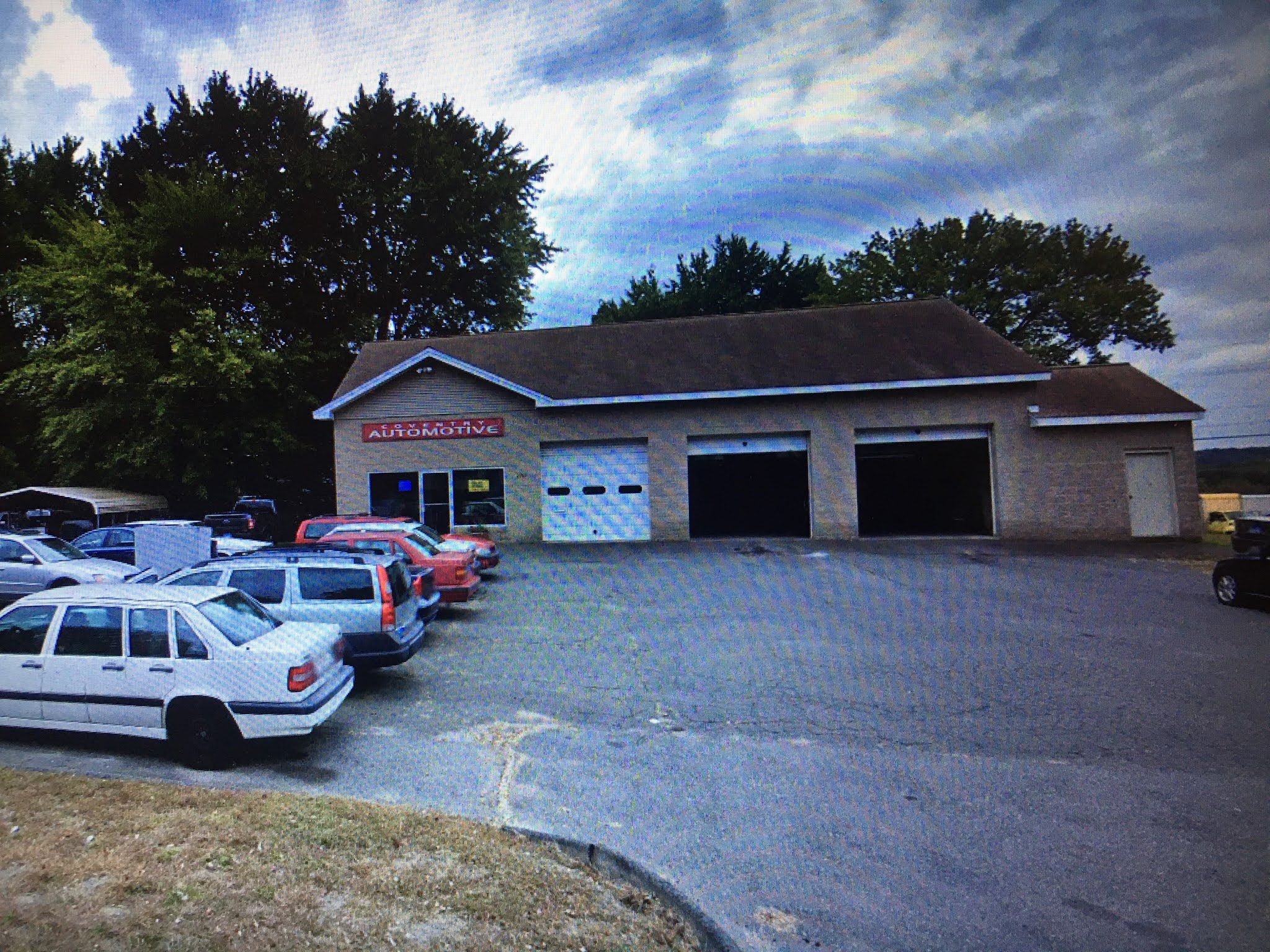
Around 1958, Dad moved his business. At first, he was going to rent
the gas station that is now Coventry Pizza (1467 South Street), but for some
reason, that didn't work out. He ended up at what is now Coventry Automotive
(2767 Boston Turnpike). That didn't last.
 |
| This new looking restaurant was once a Texaco station @ 1467 South Street. |
 |
| I don't remember what brand this was when Dad had his shop here @ 2767 Boston Turnpike. |
In either late 1959 or early 1960, Dad closed his business and went
to work for a friend, Al Booth, in a factory at 156 River Road, Willington, CT. It was the beginning of the end.
Throughout the years at Seagraves, I had some really good friends. There were the kids
in the neighborhood. And Burt (then Bud) Hansen, Pete Hoffman, John Howland (we all
went to kindergarten together), a cousin Philip Gronback, Joey
Maulucci, I'm probably forgetting many because it seemed like I had so many
friends.
We used
to play in the Nathan Hale State Forest across the street from us. Directly
across the street was a swamp, and further down Seagraves, there was a pine
forest. We used to play in the forest a lot. We'd built "huts" (just some branches put together like a lean-to), pretending we were hunting, doing kid stuff. It was a magical place.
One day, probably a Sunday, a cousin, Betty Jean Lacells, was visiting.
Late in the afternoon, as she was getting ready to leave, we couldn't find my
brother Doug. Everybody, Mom, Dad, Betty Jean, Sandy, neighbors, and I scoured
the swamp and forest. We couldn't find him anywhere. I think Mom was just about
ready to call the State Police (Coventry didn't have its own police force yet)
or the Fire Department to help find him. For some reason, Betty Jean decided to
search the house - yup, he was sound asleep UNDER his bed!
My
sister, Sandy, sent me what she remembered about the Seagraves' house
- "I do remember that what became Hotch's and your
bedroom eventually was a screened-in porch when we first got there. So,
you and I shared the sunporch for a bedroom. Closing in that porch was
the first remodeling I remember--it became the front door and hall, and our
bedroom. I think moving the door to the porch came later, and the coat
closet was put there then. Not sure why you and I shared the new bedroom,
but I remember sleeping in the top bunk there.
The next remodeling was building a kitchen where the open porch
had been, making the entry to the kitchen from the dining room where a window
had been, excavating more of the basement (and new access), and adding a new
porch to the back. I think that's when the coat closet got put in from of
where there had been a door to the porch. Oh, and the wall between the
dining room and the hallway got a large opening to make the room feel bigger.
When Hotch was almost ready to move out of the crib, they added
a closet to the sunroom, papered it in a girly flowered wallpaper, and bought a
daybed for me.
I don't remember when the garage got paneled, or why they
thought we needed a fireplace out there.
Oh, and the "rock garden" was on the opposite side of
the front lawn from the driveway, and there was a house between ours and the
"old man"--my friend Betty Bednarz lived there for a while."